


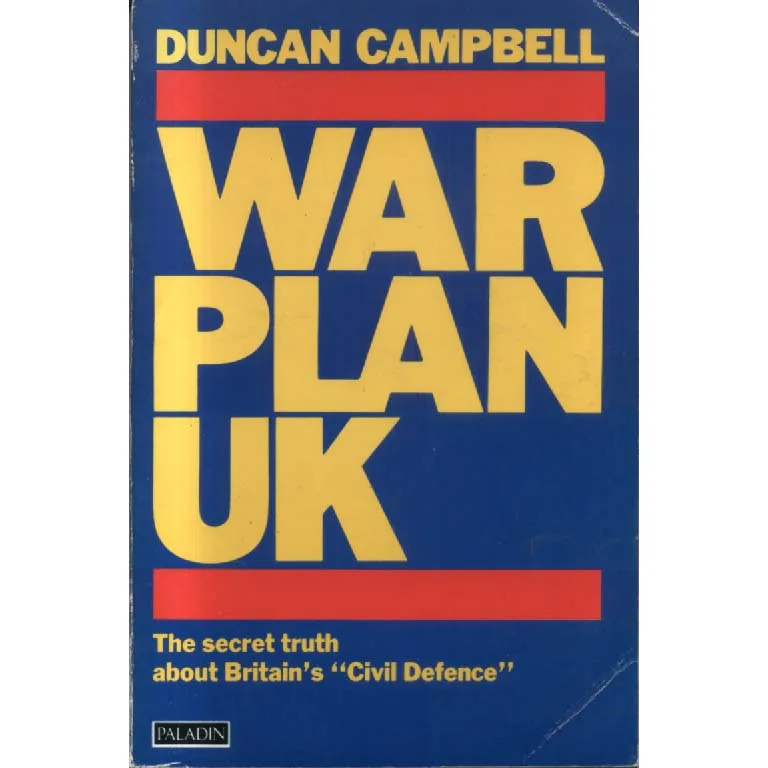
War Plan UK
Publisher: Paladin
Format: Paperback
ISBN: 9780586084793
War Plan UK (1983) – Duncan Campbell
Paladin | ISBN: 9780586084793
Condition: Fair – Fragile Binding, Repaired | Sold by Crappy Old Books
Britain in the Cold War. A reassuringly familiar landscape of suburban gardens, railway stations, village pubs and civil servants quietly preparing for the possibility that the entire country might be reduced to radioactive rubble before lunchtime. While the public was encouraged to remain calm, maintain a stiff upper lip and perhaps construct a fallout shelter beneath the vegetable patch, rather more elaborate preparations were taking place behind the scenes.
Welcome to War Plan UK, Duncan Campbell’s alarming investigation into Britain’s preparations for nuclear war, civil defence and the extraordinary machinery of government designed to function after civilisation had experienced a particularly unfortunate afternoon.
Published during the early 1980s, when relations between NATO and the Soviet Union were sufficiently tense to make even seasoned diplomats reach nervously for the whisky, this book examines the plans, institutions and assumptions underpinning Britain’s response to a potential nuclear conflict.
What would happen if the missiles actually arrived? Who would govern? How would communications survive? What arrangements existed for emergency powers, military coordination and the maintenance of public order?
And, perhaps most importantly, would anybody remain alive to appreciate the magnificent administrative arrangements?
Campbell investigates the secretive world of wartime planning, exploring the government’s preparations for national emergency, the role of regional administration and the uncomfortable realities concealed beneath official assurances about civil defence.
The book belongs to an era when nuclear strategy was discussed with extraordinary seriousness by people sitting in comfortable offices, contemplating scenarios in which millions might die while somehow maintaining the conviction that the situation could be managed through appropriate planning.
There is something magnificently British about the idea of preparing for nuclear Armageddon with committees, classified memoranda, emergency regulations and an apparently unshakeable faith in the administrative process.
After all, the end of civilisation would be regrettable, but the really unforgivable catastrophe would be discovering that somebody had failed to complete the correct paperwork.
Duncan Campbell, an investigative journalist known for his reporting on national security and government secrecy, approaches the subject with a sceptical eye, questioning the effectiveness, practicality and democratic implications of arrangements rarely exposed to public scrutiny.
The result is a fascinating piece of Cold War investigative journalism, documenting the anxieties, assumptions and official thinking of a period when the threat of nuclear confrontation was an ever-present feature of international politics.
Four decades later, the book also provides an absorbing historical snapshot of Britain’s security establishment and the extraordinary lengths governments contemplated to preserve some semblance of authority in circumstances where ordinary political life might have ceased to exist.
Condition: Fair. This copy remains very readable and presents well, but the binding is brittle. Some critical areas have been carefully reglued to strengthen the book, and it is currently holding together satisfactorily. However, it must be handled gently, as further cracks may develop along the spine if it is opened roughly or forced flat. An honest, attractive reading copy rather than one for vigorous handling.
Offered by Crappy Old Books, this 1983 Paladin edition is an intriguing acquisition for enthusiasts of Cold War history, nuclear strategy, investigative journalism and Britain’s occasionally surreal approach to national emergencies.
A disturbing, revealing and darkly fascinating examination of how Britain prepared for the unthinkable.
Because when the four-minute warning sounded, the authorities apparently had plans for almost everything.
Except, perhaps, how to persuade a thermonuclear explosion to respect the chain of command.
Keep browsing: See more War books Other books by Duncan Campbell
